
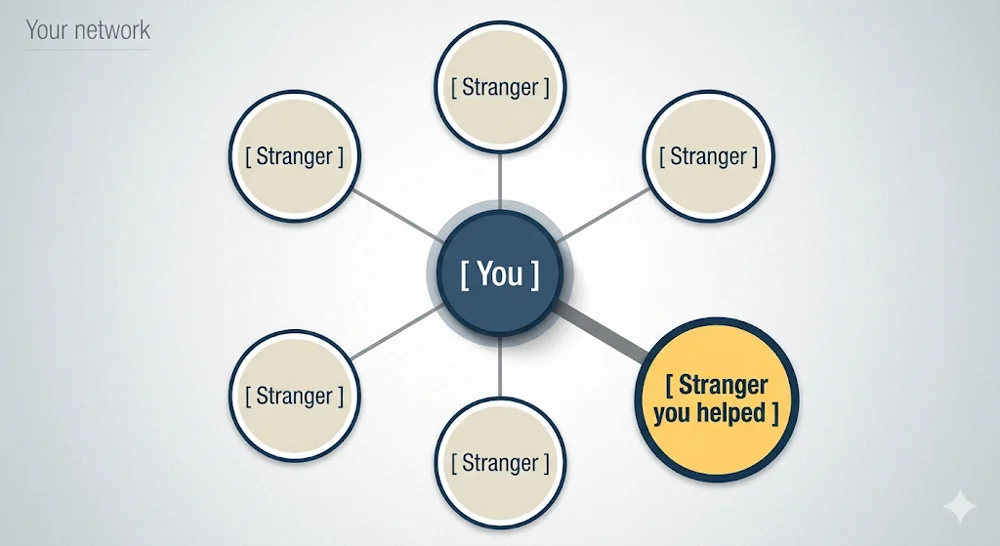
I used to think "networking" was an activity exclusively reserved for marketers in cheap suits exchanging business cards at hotel lobby bars. As an engineer, the whole concept felt inefficient.
For a long time, my approach to building professional relationships was what you might call the Naive Marketer Algorithm. I would go to a meetup, collect 10 LinkedIn connections, and then just … forget about them.
Have you been getting more messages recently? Now, armies of llms are at work, scraping your LinkedIn. It’s not spam, for some convoluted reason. "Hope you are having a productive Tuesday! I noticed you’re having trouble with [blah]. I was wondering if you’d like to try our new app."
But if you look at the ecosystems that actually produce world-changing companies—places like Y Combinator, or my own backyard here in the Waterloo technology corridor—the founders don't do this. They rely on a cultural quirk called "Paying it Forward."
Doing favors for free sounds like a nice, philanthropic thing to do. But to a technical founder, it's actually the mathematically optimal strategy for increasing network density.
The Adjacency Matrix of Trust
Let's model your professional network not as a list of contacts, but as a directed graph.
When you do traditional networking, you are essentially building a Star Graph. You are at the center, and you create hundreds of shallow, unweighted edges pointing outward.

The problem is that high-value opportunities—seed funding, a warm intro to a tier-one VC, or poaching a 10x engineer—do not travel over unweighted edges. They require a threshold of "Trust" to cross the bridge.
This brings us to the "Pay it Forward" optimization. When you solve a problem for someone else without asking for anything in return, you aren't just adding a node to your CRM. You are artificially inflating the weight of that edge.
Sociologists like Ronald Burt call this bridging "Structural Holes." In computer science, we just call it caching your graph traversals.
The Waterloo Implementation
Take the Waterloo, Ontario startup ecosystem. It’s a relatively tiny geographic footprint that somehow birthed BlackBerry, OpenText, and a startling percentage of Y Combinator’s most successful cohorts (including the founders of Pebble, Kik, and Vidyard).
Why? Because the ecosystem here forces network density.
If you spend time at the University of Waterloo's Velocity incubator or standing in line at the Balzac’s coffee shop, you’ll notice a distinct lack of transactional networking. You have seasoned founders—who were mentored years ago by legendary local professors like Larry Smith—spending their weekends reviewing pitch decks for 19-year-olds.
They are executing the Pay It Forward algorithm.
Five years down the road, when that 19-year-old builds the next unicorn, that initial 2:00 AM debugging session pays dividends. The latency to get a warm introduction to an elite node drops to zero.
You need an app
So, how do you actually implement this in your day-to-day life without forgetting who needs what?
You could use a bloated enterprise CRM designed for sales pipelines, but tracking your friends as "Qualified Leads" feels gross.
This is exactly why I built PeepDeck.app. I wanted to build a cognitive exoskeleton for your relationships.

Instead of just showing you a person's job title before a meeting, PeepDeck prompts you with one simple, mandatory query:
"What specific problem can you solve for this person today?"
By forcing you to answer this question before you walk into a coffee shop or hop on a Zoom call, PeepDeck completely rewrites your execution path. You stop thinking about what you can extract (funding, favors, sales) and start thinking about what you can inject (a helpful article, a warm intro, a piece of actionable advice).
You don't need to be an extrovert to build massive social capital. You just need to stop spamming people, start solving tiny problems for the nodes around you, and let the algorithm do the rest.